“Setting your hourly rate by dividing desired pay by 40 hours ignores the 12–15 hours a week spent driving and estimating.”
✓ With Service Zen
Calculate your rate across actual billable wrench time (typically 22–28 hours/week per technician).
If you work 40 hours a week, you rarely bill all 40 hours—drive time, parts runs, quoting and scheduling eat into the week. Use the interactive calculator below to find the minimum billable hourly rate and diagnostic callout fee your business actually needs.
Price every billable hour to cover the hours you spend driving and quoting. Built for four-season trade & service teams
“Setting your hourly rate by dividing desired pay by 40 hours ignores the 12–15 hours a week spent driving and estimating.”
Calculate your rate across actual billable wrench time (typically 22–28 hours/week per technician).
“Low diagnostic callout fees lose money whenever a tech drives 30 minutes across town for a quick check.”
Pair a clear diagnostic callout fee with your billable repair rate so travel and initial troubleshooting are always covered.
“Unorganized scheduling and manual paperwork reduce billable hours even further.”
Use Service Zen routing, quoting and invoicing to reclaim non-billable hours and fit more paid visits into the week.
Between winter road conditions, supplier counter runs and quoting, field pros typically bill 22–28 hours out of a 40-hour week. See what each billable hour must earn.
Keep diagnostic callout fees and repair labour on separate line items so clients see exactly what they are approving.
A $42/hr licensed tech actually costs $50–$53/hr per clock hour once CPP, EI, WSIB/WCB, vacation pay, statutory holidays and benefits are included.
Because only ~25 of 40 paid clock hours are billed on site, each *billable* hour must cover 1.6 hours of paid technician wages.
Fuel, commercial insurance, maintenance, snow tires, shelving and diagnostic tools typically run $22,000–$32,000/year per truck.
Once true burdened labour ($80/billable hr), van/office overhead ($45/billable hr) and net profit margin are totaled, profitable trade rates rarely sit below $125/hr.
See why charging $85/hr when paying a tech $40/hr loses money—and how a sustainable rate breaks down.
Efficiency Lever: Reclaiming just 3 hours of drive/admin time per week (moving from 25 to 28 billable hours at $155/hr) adds $23,250/year in revenue per van with zero extra payroll!
Track how many hours a technician is actively on site performing billed work (often 55%–70% of total clock hours).
Include fuel, truck payments, liability insurance, tools, marketing and software divided across working weeks.
Charge a dedicated diagnostic/callout fee to cover dispatch and initial assessment, then bill approved repair work on its own line item.
Every hour saved on route backtracking and evening invoicing adds another billable hour to your week inside Service Zen.
When route optimization and faster quoting move a technician from 24 to 27 billable hours a week at $115/hr, that single van generates over $17,000 in additional annual revenue without working longer days.
Customers appreciate transparency. In Service Zen, you can bill the diagnostic visit clearly and present a separate line-item quote for the repair before starting work.
Use Service Zen timesheets and job records to compare scheduled duration against actual time on site and refine your pricing.
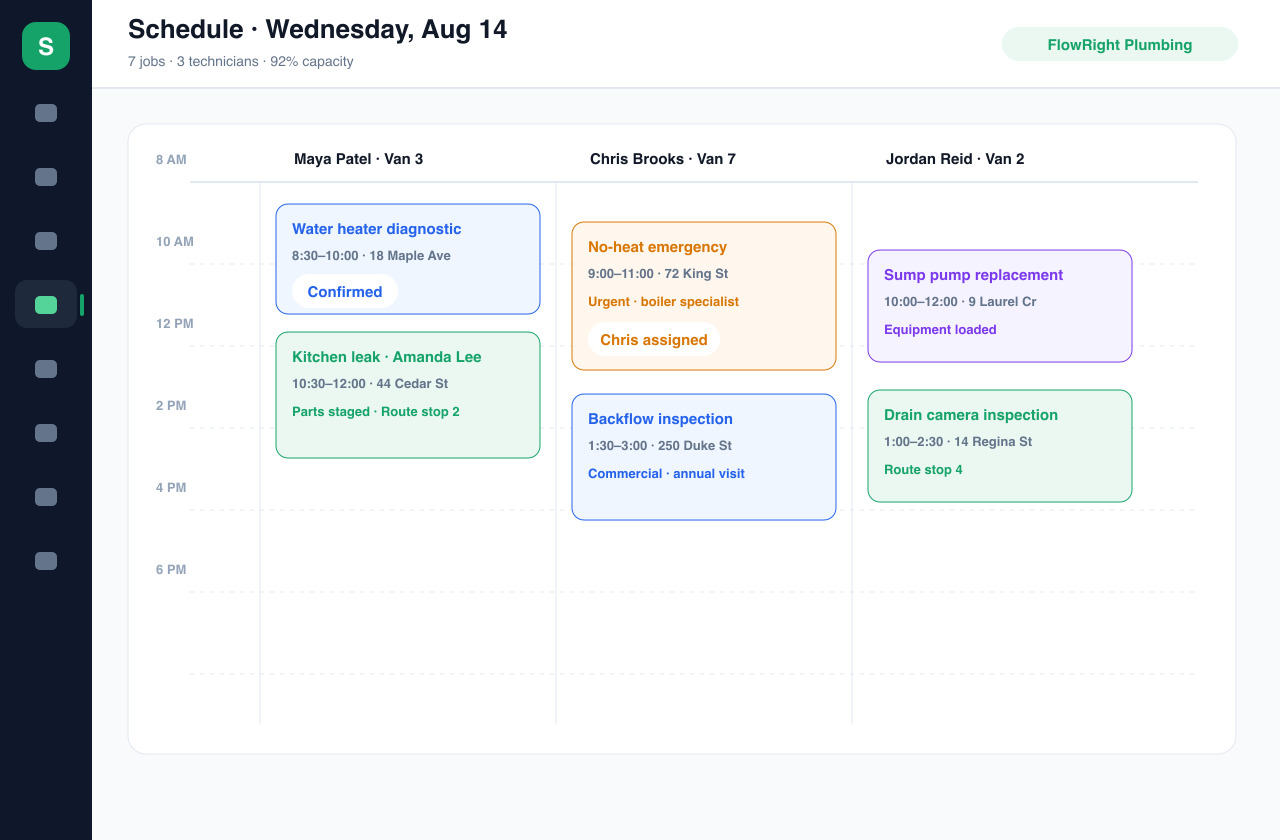
Across plumbing, HVAC, electrical and appliance repair, technicians commonly average 22 to 28 billable hours out of a 40-hour week once travel between stops, parts pickups and admin are accounted for.
Charging a clear diagnostic or callout fee covers travel time and professional troubleshooting so your business is compensated even when a customer decides to replace an old unit rather than repair it.
Service Zen reduces non-billable time by combining scheduling, route planning, fast quoting, client reminders and one-click job-to-invoice billing in one place.
Explore the live demo, test a workflow, or compare our current plans.